
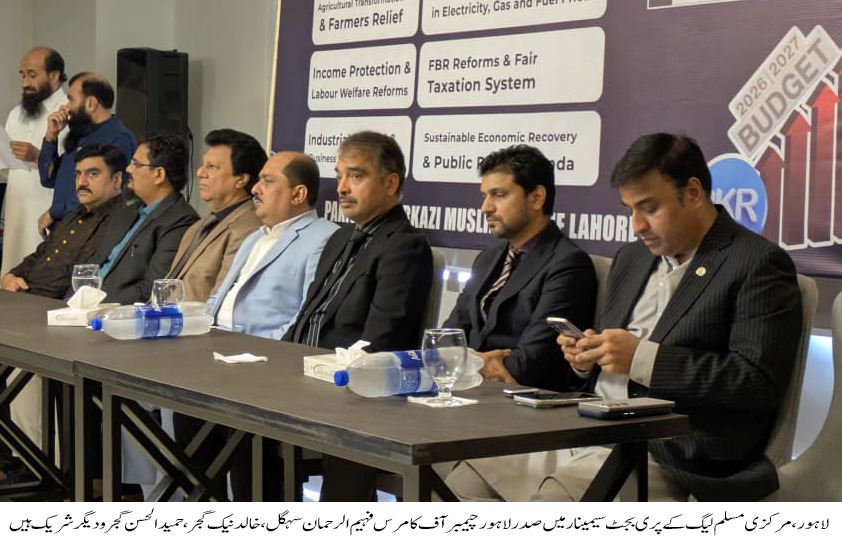
At a pre-budget seminar organized by the Traders Wing of Pakistan Markazi Muslim League, industrialists, business leaders, and agricultural experts emphasized the urgent need for relief measures and business-friendly policies to help industry, trade, and agriculture overcome Pakistan’s economic challenges.
The speakers stressed that sustainable economic growth and stability cannot be achieved without promoting manufacturing, revitalizing agriculture, and creating employment opportunities for the country’s youth.
The seminar was addressed by Lahore Chamber of Commerce President Faheem-ur-Rehman Sehgal, Pakistan Markazi Muslim League Deputy Secretary General Khalid Naik, Lahore General Secretary Chaudhry Hameed-ul-Hassan Gujjar, PIAF member Mudassar Masood, Chairperson Punjab Milli Adab and Lahore Chamber member Riaz Ahmed Ahsan, Agrovat Forum President Dr. Rizwan, and several other business leaders.
In his address, Lahore Chamber of Commerce President Faheem-ur-Rehman Sehgal said that Pakistan is a country blessed with immense resources and potential, but requires the right direction and effective leadership to achieve economic progress. He stated that a strong economy is the foundation of a strong defense and that all segments of society must raise a united voice for national development.
He further noted that Pakistan’s 65 percent youth population can become a driving force for economic stability if provided with opportunities in information technology, industry, and entrepreneurship.
Other speakers highlighted that promoting manufacturing and implementing business-friendly policies would boost exports, create new employment opportunities, and stimulate industrial activity. They described high interest rates, expensive energy, and rising production costs as major obstacles to economic growth and called for a reduction in government expenditures.
The speakers also emphasized that agriculture remains the backbone of Pakistan’s economy and requires urgent intervention. They proposed the declaration of an agricultural emergency and the establishment of specialized agriculture-industrial zones, stating that these measures would increase agricultural productivity and pave the way for sustainable economic development.
Participants at the seminar expressed their commitment to strengthening the industrial, trade, and agricultural sectors, believing that these efforts would help Pakistan achieve economic growth, self-reliance, and long-term prosperity.